Ezekiel’s Symbolic Acts and God’s Judgment on Jerusalem
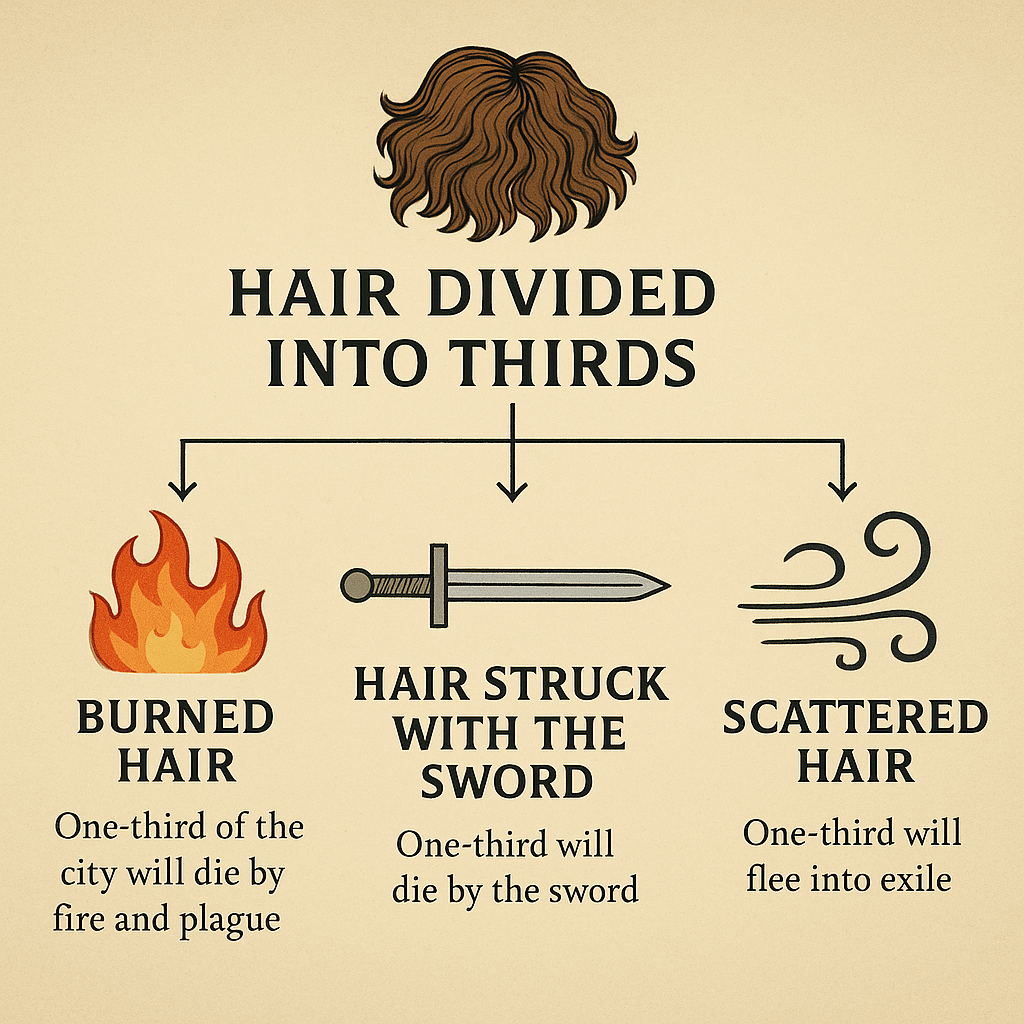
God instructed the prophet Ezekiel to shave his head and beard—a culturally significant act symbolizing mourning and humiliation. He was then to weigh and divide the hair using scales, carrying out three distinct symbolic actions:
- One-third was to be burned in fire in the midst of the city once the days of the siege were completed.
- One-third was to be struck with the sword all around the city.
- One-third was to be scattered to the wind, symbolizing dispersion.
Ezekiel was then told to take a small number of the remaining hairs and bind them in the edge of his garment—representing a remnant that would be preserved. However, even from these, he was to take some and burn them in the fire, showing that even among the remnant, some would face judgment.
These symbolic acts reflected the judgment God was about to bring upon Jerusalem. The people of Israel had rebelled against God’s statutes and committed greater wickedness than the surrounding nations. As a result, God declared He would execute judgment in the sight of all nations: God executed judgement against Jerusalem in the midst of the nations all around.
“…therefore thus says the Lord God: ‘Indeed I, even I, am against you and will execute judgments in your midst in the sight of the nations. 9 And I will do among you what I have never done, and the like of which I will never do again, because of all your abominations.”
Ezekiel 5:8-9
Because of their abominations, God declared that extreme consequences would follow:
- Fathers would eat their sons, and sons their fathers.
- The sanctuary of God had been defiled with detestable things.
- A third of the people would die from pestilence and famine.
- Another third would fall by the sword.
- The remaining third would be scattered among the nations.
God’s fury would be poured out, and His justice executed. Through this, the people would know that the LORD had spoken.
This chapter serves as a sober reminder: God is holy and just. Persistent disobedience, rebellion, and abomination bring judgment.
Let us, therefore, walk in repentance and faith.
Let us fear the Lord while there is still time.
Let us obey His Word and live in reverence of His holiness.

 Faith With Petra